There is nothing magical about the turning of the calendar.
We aren’t fundamentally different during the last week of December than we are during the first week of January.
Yet, it’s undeniable that we feel a renewed sense of possibility that comes with a new year. One of those areas we often turn our attention to is wellness. We recognize the areas where our health is lacking and look to shore up those areas.
As a new year dawns, let’s take seriously the words of the Apostle Paul in 1 Corinthians 6, when he refers to our bodies as “temples of the Holy Spirit” and in 1 Corinthians 10, when he calls us to do “whatever we do to the glory of God.”
Managing our emotions and pursuing emotional wellness falls squarely in this area. This year has been an emotional roller coaster. Many of us have felt intense and painful emotions this year. How do we feel and express our emotions in ways that lead us toward, and not away from health?
All of these emotions come with such strength that they feel like crashing waves. Many times, I feel like a newbie learning how to surf. The break keeps crashing on me and I wonder if I will ever be able to ride a wave successfully.
So, when I turn to the Bible, I am reminded that my emotions are not bad. My emotions cannot be bad because Jesus had them and expressed them throughout the Gospels. Consider the following emotions Jesus expressed.
- Joy
“I have told you these things so that you will be filled with my joy. Yes, your joy will overflow!” - John 15:11 - Anger
“When Jesus saw her weeping and saw the other people wailing with her, a deep anger welled up within him, and he was deeply troubled.”- John 11:33 - Grief
“Then Jesus wept.” - John 11:35 - Compassion
“When he saw the crowds, he had compassion on them because they were confused and helpless, like sheep without a shepherd.” - Matthew 9:36 - Frustration
“Then he asked them, ‘Why are you afraid? Do you still have no faith?’” - Mark 4:40
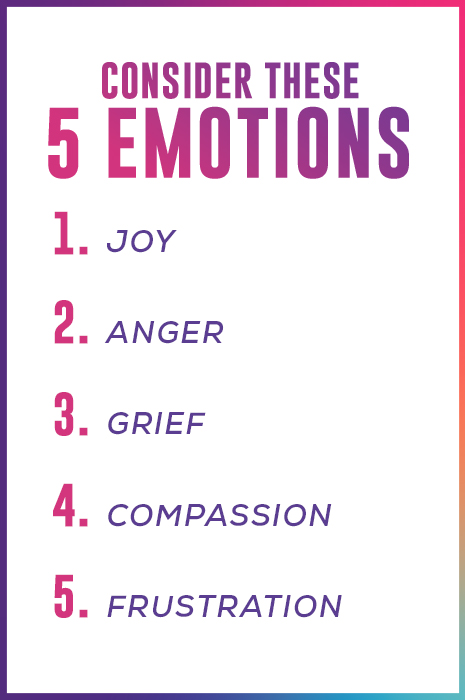



It’s comforting to me that Jesus felt anger, grief, and frustration because I have felt those things this year. But I’ve not always felt, or expressed, them in ways that made me feel good, much less well. My anger has led to regret. My grief has led to discouragement. My frustration had led to self-destructive actions.
But, when I see Jesus expressing emotions, I’m reminded of the words of John 1:14: “So the Word became human and made his home among us.” Jesus was fully human, hence all the emotions, yet fully God. He lived a human life, yet without sin!
We have three choices when faced with our emotions.
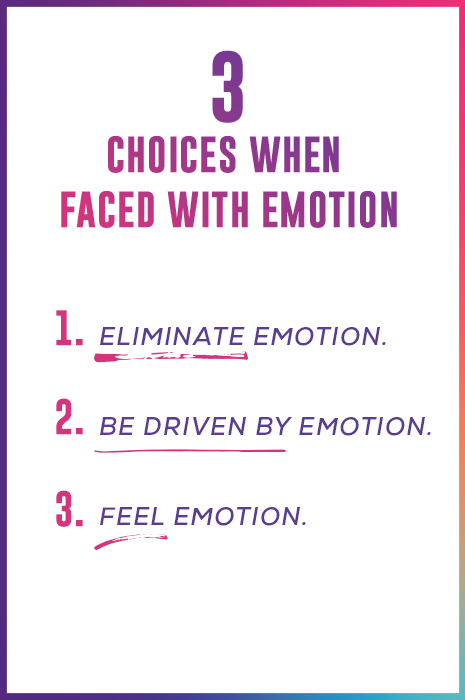
1. Eliminate emotion.
I know it sounds crazy, but I know people who have tried to eliminate their emotions. They’ve tried to go the path of Spock from Star Trek, all logic and no emotion. If we could eliminate our emotions, then they wouldn’t be a source of sin or pain.
2. Be driven by emotion.
Most of us know what this feels like. Think of the movie Inside Out and how different emotion-named characters take over control of the mind of the young girl, Riley. When any of our emotions are driving our lives, we’re in danger of causing a wreck.
These first two options are ditches that we all have fallen into from time to time. However, if we can learn anything about emotional wellness from Jesus, it’s that there is a third option. A middle way of sorts.
3. Feel emotion without being fueled by emotion.
God created our emotions. We see Jesus expressed his emotions, so emotions cannot be evil or something to avoid. On the other hand, the Apostle Paul cautions us, saying in Ephesians 4 "don't sin by letting anger control you." Another translation renders that same verse “be angry and do not sin.”
The problem isn’t our emotions; it’s what we do with them and what they do with us. Jesus embraced grief, anger, joy, compassion, frustration, weariness, happiness, and peace. He felt them all, but his life and ministry were never sustained by emotion.
After a year like this, my greatest temptation is to try and close myself off to negative emotions. In the new year, I don’t want to feel any more anger, grief, or disappointment. But when I think of shutting off those seemingly negative emotions, I think of a good friend’s favorite quote from C.S. Lewis.

“To love at all is to be vulnerable. Love anything and your heart will be wrung and possibly broken. If you want to make sure of keeping it intact you must give it to no one, not even an animal. Wrap it carefully round with hobbies and little luxuries; avoid all entanglements. Lock it up safe in the casket or coffin of your selfishness. But in that casket, safe, dark, motionless, airless, it will change. It will not be broken; it will become unbreakable, impenetrable, irredeemable. To love is to be vulnerable.”
Being emotionally well means embracing vulnerability and the emotions that come along with it. To be human is to be vulnerable in God’s presence and with people. Like Adam and Eve, our sin tempts us to hide and run from our emotions. But, like He did with Adam and Eve, God invites us out of the shadows and into the light. Jesus knows what we’re feeling, and He has felt those same things.
When you think about wellness in this new year, consider how you can choose that middle way. Allow yourself to feel every emotion God created you with, yet invite Him into those feelings so He can guide you in expressing your emotions in ways that honor Him.
Be emotional and do not sin.
Scott Savage is a pastor and a writer with the coolest last name ever. He leads Cornerstone Church in Prescott, Arizona. Scott is married to Dani and they are the parents of three “little savages.” He helps hurting people forgive others through his Free to Forgive course and you can read more of his writing at scottsavagelive.com