Do you remember the first label someone placed on you as a child? Maybe your first nickname that pulled from some quality you were ashamed of.
One of my friends heard the word “fat” for the first time at four, from her mother. She told her to suck in her belly.
Four. Years. Old.
Another friend heard the word “stupid” before he could even spell it. I met a man a few years ago whose father told him he’d be “nothing,” just like his mother. He told me of his battle to reject that word over the past thirty years.
The words others have spoken over us can linger long after those relationships end. Those words can stick in our souls even after the people who spoke them have died.
The First and Second Most Important Things about Us
In his book, The Knowledge of the Holy, A.W. Tozer writes, “What comes into our minds when we think about God is the most important thing about us.” I agree with Tozer, and I’d like to add to his comment. If the most important thing about us is what we think when we think about God, then the second most important thing is what we think God thinks about when God thinks about us.
Our image of God and God’s image of us. They are connected and profoundly important. How we view God and how we view ourselves will shape our future.
Those views are shaped during key moments of our lives, and then we carry those views on into the future.
The Words Jesus Heard
During a key moment of His life, Jesus heard some words which would shape his future ministry.
In Mark 1, Jesus travels to the Jordan River to be baptized by his cousin, John. Here’s what happens next. “As Jesus came up out of the water, he saw the heavens splitting apart and the Holy Spirit descending on him like a dove. And a voice from heaven said, ‘You are my dearly loved Son, and you bring me great joy.’”
Recorded in Mark 1:11, those English words “dearly loved” are translated from the Greek word agapetos. This word comes from the well-known Greek word agape, which describes the love of God - unconditional and unchanging.
Several years ago, as I was listening to someone teach on this text, it hit me that Jesus had done no acts on earth to deserve this statement. He had performed no miracles, healed no one, delivered no sermons, and called no one to follow Him. This statement came before the beginning of His public ministry, not after it.
The Father speaks this identity over the Son as a gift to be received, not a status to be earned. As those who have received the gift of salvation in Christ, by grace through faith, what is true about Christ is now true about us. In Colossians 1, the Apostle Paul writes, “For God wanted them to know that the riches and glory of Christ are for you Gentiles, too. And this is the secret: Christ lives in you. This gives you assurance of sharing his glory.”
The words Jesus heard in the waters of the Jordan are now true about us. But that is so hard to believe and embrace.
What God Says About You
Since many of us have heard all sorts of words spoken over us, hearing that we are God’s dearly loved sons and daughters is a tough message to embrace. Since we’ve been labeled by others, it’s hard to embrace the label of God which says that we are people who are “dearly loved” and who bring Him “great joy.”
As someone who struggles to believe that I am dearly loved by God, apart from my performance, here are four truths I’ve meditated on and explored regularly.
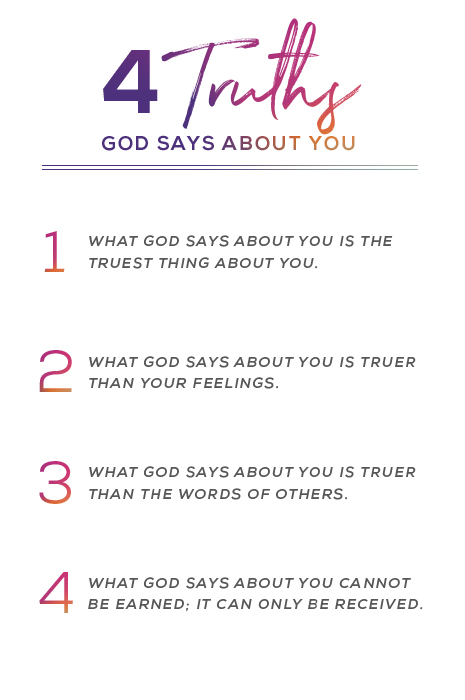
1. What God says about you is the truest thing about you.
Since God created me and knows everything, His perspective trumps that of everyone else. Psalm 139 describes His knowledge of us from creation and Romans 8 describes the love He has for us. God knows us better than everyone else and He loves us more than anyone else. Embracing our identity in Christ means believing that what God says about us is the truest thing about us.
2. What God says about you is truer than your feelings.
Our feelings are too often the grounds of our self-esteem and self-worth. Yet our feelings change based upon fickle things like what we had for lunch or what we scrolled past on social media. God’s words about us are consistent and unchanging. Jeremiah 31 says that God loves His people with “an everlasting love.” When my feelings threaten my identity as “dearly loved,” I remind myself “what God says about you is truer than your feelings.”
3. What God says about you is truer than the words of others.
It’s amazing how much weight we give to the words of people we don’t like, much less love. We give great weight to the words of others who we know don’t truly love us or have our best interests in mind. Yet we embrace their words about who we are. The problem is their labels lie. They don’t know us like God does. They haven’t done for us what God has. They will abandon us; God promises to never leave us, nor forsake us. When tempted to trust in the words of others, I work to put a stop to that train of thought in order to consider God’s truer words about me.
4. What God says about you cannot be earned; it can only be received.
I was talking with my counselor this week about my battle to believe the words of Mark 1:11. (Even though I’m writing about this, there are still times in my life where it’s a battle to believe it). He put the experience of Jesus into powerful words for me. He said...
“Scott, any true identity is always bestowed, never earned.”
Jesus didn’t earn these words from His father - He received them. The Father bestowed these words on the Son and now He is bestowing them on us. What God says about us cannot be earned; it can only be received.



Take time this week to read and meditate on Mark 1:11 and ask yourself “what kind of identity has God bestowed on me? How can I receive it, instead of earning it?”
Scott Savage is a pastor and a writer who believes he has the best last name ever. He leads Cornerstone Church in Prescott, Arizona. Scott is married to Dani and they are the parents of three “little savages.” He is the creator of the Free to Forgive course and you can read more of his writing at scottsavagelive.com.