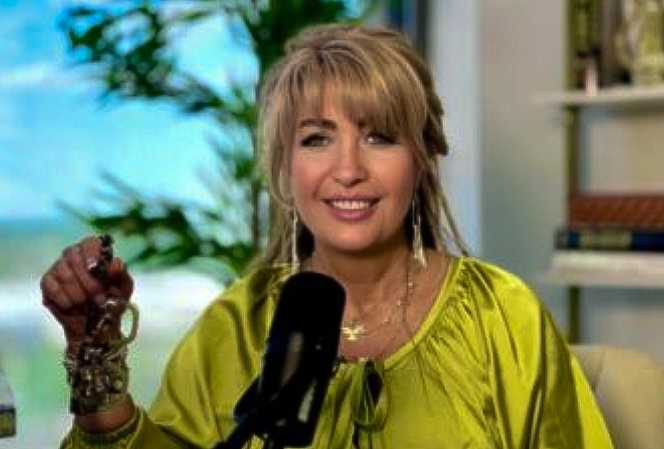
(Virginia Beach, VA) - There are moments in life when everything changes in an instant.
For Dr. Isik Abla, that moment came in a workplace restroom in Miami, when she was at the lowest point of her life and had decided she no longer wanted to live.
What happened next would transform not only her life, but eventually become the foundation of a ministry devoted to telling people around the world about Jesus.
“I knew He was real,” Abla recalls. “And I knew He was in the room. And I knew He was the only way.”
Today, Abla is an international speaker, author and Christian ministry leader. But her journey to faith began in a childhood marked by violence, fear, abuse and profound spiritual questions.

Abla was raised in Turkey in a devout Muslim home during a period of civil unrest.
“There was war everywhere,” she recalls. “There was war and fighting inside the house that I grew up. And there was war on the streets because there was a civil war.”
As a child, she witnessed horrific violence.
“I grew up seeing people killing each other in front of me,” she says. “I saw bloodshed. I saw arms and legs flying in air.”
Her home offered little refuge. Abla says her mother struggled with depression and that her father was abusive.
Searching for answers, she turned toward the faith she had been taught from childhood.
“I turned to Allah, the only God that was represented in a Muslim country,” she says. “But I couldn't find answers because he was an impersonal, hateful, angry God.”
Abla says she also learned at a young age that her gender made her inferior to men.
“And I accepted that,” she says. “And I accepted abuse. I accepted a lot of traumatic events as part of my life.”
She immersed herself in Islamic teaching, memorizing much of the Quran. At age 12, she attended what she describes as a radical Quran course.
“I was brainwashed to hate infidels, mostly Christians and Jews,” she says. “I was brainwashed that what Western world called terrorists weren't terrorists. They were heroes.”
The teaching had a profound effect.
“I started dreaming about becoming a suicide bomber at age 12,” Abla says.
As she grew older, Abla's circumstances remained difficult. She eventually married a radical Muslim man whom she says repeatedly abused her.
“He was beating me up every other day, disciplining me according to Sharia law to become a better Muslim woman, so to say,” she recalls.
Eventually, she fled Turkey after she says her husband attempted to kill her several times.
Her escape brought her to America—a country she describes as wonderful and free.
But freedom on the outside did not immediately mean freedom on the inside.
“I came to America to a different, wonderful, free country, but in my own chains, invisible chains,” Abla says.
After experiencing further abuse, she eventually reached a breaking point.
She had decided to take her own life.
That morning, Abla says she woke up convinced that life was no longer worth living.
“I started hearing this voice, ‘Life is not worth living,’” she recalls. “And I failed in every area of my life.”
Although she had a strong educational background, she says she felt incapable of fixing the brokenness inside her.
She went into the restroom at work and began crying out to God.
“At that time, I didn't know even which God I was talking to,” she says.
Abla was still, in her heart, a Muslim. She says she never imagined becoming a Christian.
“I believe I was born Muslim. I was going to die Muslim,” she recalls.
But there was an internal conflict growing inside her.
She had begun attending Bible studies at her workplace, and what she heard about Jesus was unlike anything she had encountered before.
“Everything I was hearing about Jesus was so amazing,” she says. “Unconditional love and grace.”
“I never heard the word grace. And I was so puzzled.”
In her desperation, she cried out:
“Why do you hate me? And okay, you win. I lost.”
Then she made a decision.
“I decided at that very moment… I'm going to take my life.”
She cleaned her face, returned to her desk—and then her Christian boss called her into his office.
According to Abla, her boss told her something she could not have known he knew.
“He started telling me that Jesus knew about my plans,” she recalls.
He told her, “I have never done this in my life before. But I have to be obedient.”
Then he delivered a message that Abla says changed everything.
“Jesus wants me to tell you, you are never forsaken, nor abandoned,” he told her. “He was always with you. Even when you were suffering, when you were tormented, when you were abused and molested, Jesus was by your side.”
Then came the question:
“Do you want to receive Him as your Lord and Savior?”
Abla didn't understand Christian theology. She didn't understand the Trinity. She didn't understand how Jesus could be the Son of God.
But she says she knew one thing.
“I knew He was real. And I knew He was in the room. And I knew He was the only way.”
“And I said, yes.”
Abla describes her encounter with Jesus as something tangible.
“At that very moment, it was tangible,” she says. “It wasn't intangible, just believing. I knew He was real. I knew He was in the room.”
She says she felt as though Jesus were embracing her.
“I knew almost like He was hugging me,” she recalls.
Then something lifted.
“All these tons of weight, I didn't know that I was carrying, lifted off my shoulders.”
Her circumstances did not instantly change, but her understanding of her life did.
“Maybe everything, every circumstance doesn't change,” she says. “But I knew that I knew that He was by my side.”
“And there was light at the end of the tunnel.”
Then comes perhaps the most powerful description of her transformation:
“And that suicidal woman was gone. And there was a new creation.”
The hatred she had carried for years was replaced by something entirely different.
“I was full of hatred before. And I was full of love.”
Abla says she didn't know much Scripture when she first became a Christian.
She didn't know how to conduct ministry. She didn't have theological training that explained everything she had experienced.
But she knew what Jesus had done for her.
“I didn't even know a single scripture,” she says. “And I couldn't shut up. I keep telling people about Jesus and He saved my life.”
Within her first week as a Christian, she says she had already led several people to Christ.
Her evangelism began with something simple: her testimony.
“I started winning people to Christ through my testimony,” she says. “Just telling people what He did for me.”
She came to Christ in the year 2000.
More than two decades later, she has never stopped sharing her story.
“I never stopped telling people,” she says. “I couldn't stop telling people.”
What began with one transformed life eventually grew into a ministry reaching people across cultures and nations.
Abla began preaching, teaching and sharing her testimony in churches, on the streets and in prisons.
After the terrorist attacks of September 11, 2001, she says interest in Islam increased, creating new opportunities to share her testimony.
Eventually, a television network asked her to preach the Gospel to people in the Muslim world.
The response was initially hostile.
“At the beginning, I only received comments or messages,” she says. “‘We want to kill you. We want to cut you to pieces. And we hate you.’”
But something began to change.
The messages that followed were very different.
“Then it turned into, ‘Can Jesus help me too? If He did it for you, can He do it for me too? Because my life is just like yours.’”
For Abla, those messages represent the reason she continues to go.
Abla says she has traveled through Muslim countries as a solo female traveler, sharing the Gospel in marketplaces and speaking with people one-on-one.
“And I still do,” she says. “And I lead people to Christ.”
“It is just my new DNA. I just cannot help it.”
She describes the work as one of the greatest joys of her life—but also acknowledges the cost.
“It is the greatest joy, but it is not easy. It has a cost.”
That cost has included death threats and opposition from groups seeking to stop her ministry.
“Terrorists wrote to me, ‘We want to kill you until the last drop of our blood,’” she recalls. “My blood, one of them wrote to me, ‘I want to find you and kill you.’”
Abla acknowledges that those threats hurt.
“I struggle. I am a human being. I get hurt. I still live in the flesh time to time.”
But she says she chose to respond according to the teachings of Jesus.
“My Jesus told me to love your enemies,” she says. “I was just like you. I totally understand why you want to kill me.”
She says that approach has even opened doors to share Christ with people who once wanted her dead.
“And I started leading terrorists to the Lord, most dangerous people to the Lord.”
“My Jesus told me to love your enemies. I was just like you. I totally understand why you want to kill me.”
Abla also recounts moments when she believes God protected her during dangerous ministry assignments.
“He made me in some of those countries invisible,” she says.
There were times when groups of Muslims tried to harm her, while other Muslims intervened to save her.
“A group of Muslim women saved my life in some Muslim countries,” she says.
“God always sent a rescue to me.”
Yet Abla emphasizes that following Jesus does not mean recklessly pursuing danger.
“I really want to operate in the Holy Spirit,” she says.
“There is wisdom in not being brave in your flesh to a point of stupidity.”
Her approach to evangelism is also relational.
Rather than simply confronting people, she follows what she sees as Jesus' example of asking questions, listening and meeting people where they are.
“I go to the marketplaces, I speak to people and I ask them questions,” she says.
“Do you consider yourself a good Muslim?”
“Do you have any needs?”
“Do you need a miracle?”
She listens to people's struggles and pain.
“I become relevant just like Jesus did to their pain,” she says.
“I don't quote scriptures from the get-go or give them a Bible.”
Instead, she seeks to follow the example she sees in Scripture.
“I do in a very wise way that Jesus taught me from the scripture. And I follow that example.”
“And it works. It still works.”
Abla believes Christians seeking to reach people from different cultural and religious backgrounds must begin with compassion.
“One thing that I think we all have is a certain level of prejudice,” she says. “And I had that too.”
She believes Christians should ask God to give them compassion and teach them to communicate truth with love.
“I think God has to give us compassion and His ways of speaking truth in love, not hitting anybody with the Bible.”
Abla says she does not want to participate in what she describes as “ugly Christianity.”
“I don't want to be part of a group of Pharisees that are casting the stones,” she says.
“But I want to be operating in the heart of Jesus and in the heart of the Father.”
For her, prayer is an essential part of reaching nations.
“Our prayers can reach to the nations that we cannot go,” she says.
There are places she says she cannot safely travel, but prayer has no such limitations.
“I cannot go right now to Turkey or Iran. My life will be in danger. But my prayers can go.”
Pointing to Psalm 2:8, she encourages believers to pray boldly for nations.
“He didn't say maybe you should pray. He said, ask me.”
“It was a command and it was an order.”
Those who want to follow Abla's ministry can find her online by searching her name, Isik Abla.
Her name carries a special meaning.
“Isik Abla,” she explains, means “Sister Light” in Turkish.
The name seems particularly fitting for a woman whose story is defined by a journey from darkness into light.
Her childhood was marked by violence.
Her early adulthood was marked by abuse.
She came to America carrying invisible chains.
And then, at her lowest moment, she says she encountered Jesus.
Now she spends her life telling others about the One she believes rescued her.
Abla's message to Christians is ultimately a call to surrender rather than self-reliance.
“We try to fight so hard our battles in the flesh,” she says. “And when we fight in the flesh, we are not really allowing God to intervene.”
“Our battle cannot be fought in the flesh right now.”
She believes God is still working in places where circumstances may appear hopeless.
“God says the battle is mine.”
And she points believers back to a familiar biblical promise:
“Not by might, not by power, but by the Spirit, says the Lord.”
Abla also encourages people to read her book, Heavenly Whispers, a 365-day devotional focused on trauma healing and encouragement.
“It is a 365-day trauma-healing, encouraging devotional that I wrote,” she says.
She says the book is being read by Muslims and used as a discipleship tool among new believers.
Her story is ultimately about more than one woman's escape from a painful past. It is a testimony of what she believes God can do with a life that once seemed beyond repair.
The girl who witnessed violence grew into a woman who travels into places where she may face danger to tell others about Jesus.
The woman who once wanted to die now spends her life proclaiming a message of hope.
The woman who once says she was “full of hatred” now describes herself as “full of love.”
And the woman who once felt abandoned now says she knows she is never alone.
“I knew that I knew that He was by my side,” Abla says.
“And there was light at the end of the tunnel.”
For Dr. Isik Abla, that light became a calling—and she continues to carry it to others.
“I never stopped telling people. I couldn't stop telling people.”