
Andy Flute once lived for the roar of the crowd and the discipline of the ring. As a former captain of the English boxing team, he stood on the edge of a promising, world-class career. But behind the victories and the reputation, a quieter battle was unfolding—one that would eventually pull him into addiction, prison, and personal collapse. Today, Flute tells a very different story, one rooted not in titles or trophies, but in faith, recovery, and a mission to help others rebuild their lives.
In a recent interview, Flute reflected on how boxing shaped his early identity. “I had a lot of pride. Boxing led me self-disciplined and I wanted to make something of myself,” he said. Coming from what he described as an uneducated background, boxing wasn’t just a sport—it was his pathway forward. It gave him structure, purpose, and a sense of worth. But it also became intertwined with a growing sense of invincibility that would later prove dangerous.
(We invite you to listen to the conversation between Jalon Caldwell and Andy Flute in the podcast below).
Success and Struggle Collide
Even at the height of his boxing career, cracks were forming beneath the surface. Flute admitted that his struggles with alcohol began early and followed him throughout his time in the sport. “I started celebrating my victories with a drink of alcohol. It followed me all the way through my career,” he said. While he managed to maintain a level of control during competition, the habit was already taking root.
At the time, Flute believed he could balance both worlds. “I thought I could do both. I thought I was unbeatable,” he recalled. That mindset—common among elite athletes—masked the reality of what was building internally. The discipline he learned in the ring did not fully translate outside of it, and once the structure of professional boxing began to fade, those unresolved struggles intensified.
Hitting Rock Bottom
Flute’s descent into addiction and a life marked by violence and crime eventually led him to prison. Reflecting on those years, he speaks with a tone of deep regret but also clarity. “My only regret in life is not finding Jesus early in my life,” he said. It’s a statement that captures both the weight of his past and the lens through which he now views it.
For years, Flute tried to regain control on his own. Rehab programs and support groups introduced him to the idea of a “higher power,” but he initially resisted it. “I didn’t really believe in nothing like that. I thought I could do it myself,” he explained. What he described as being “battered and battered and battered”—left him with nowhere else to turn.
That breaking point became a turning point.
A Moment of Transformation
At his lowest, Flute says he cried out to Jesus in desperation—and believes he received an immediate answer. “I cried out and I meant it with all my heart and I got answered,” he said. “The Lord was there. He met me at my worst.”
From that moment, Flute describes a complete transformation. He points to scripture to explain the change, referencing 2 Corinthians 5:17 about becoming a “new creation.” For him, this wasn’t symbolic—it was practical and immediate. “He just took my addictions to alcohol and drugs away,” Flute said.
The shift extended into even the smallest areas of his life. He recalls a moment in a boxing gym when he nearly took a roll of tape that didn’t belong to him. “I went to put it in my bag and I couldn’t take it,” he said. “Then I knew I was totally changed.” For Flute, that seemingly minor decision represented a profound internal shift—one that signaled a new moral compass and a different way of living.

Writing as Healing
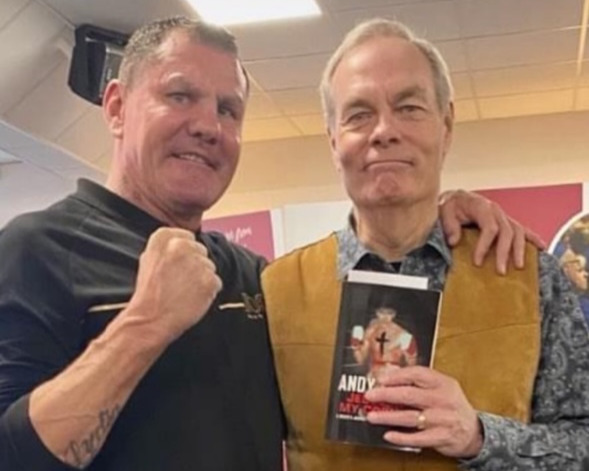
During his recovery, Flute began writing what would eventually become his memoir, Jesus In My Corner. Uniquely, the book was written entirely by hand, often on scraps of paper. The process was not initially intended for publication but served as a form of personal therapy.
“I started writing it for psychological [reasons], because I lost my way,” he explained. “Putting things down on paper helped me to recall what I’d been through.” The act of writing allowed him to reconnect with who he once was, while confronting the reality of who he had become.
The result is a raw and unfiltered account of his life. Flute himself acknowledges its rough edges. “It’s not really well written, but it’s raw and honest,” he said. That honesty, he believes, is what has allowed the book to resonate with readers, particularly those facing similar struggles.
A New Mission: Reaching the Lost
Today, Flute spends much of his time speaking in prisons and schools, sharing his story with audiences who often see themselves reflected in his past. His experiences behind bars have given him a unique ability to connect with inmates in a way that many others cannot.
“I was a prisoner myself. I can reach these prisoners,” he said. “They can recognize with me.” That credibility has led to powerful moments during his visits. In one instance, Flute described receiving a standing ovation from inmates after sharing his testimony.
In another, even more striking example, he spoke at a high-security Category A prison where 28 inmates responded to his message by committing their lives to faith. “It was better than winning any fight,” Flute said. The impact didn’t stop there—the prison organized baptisms for the inmates within ten days.
For Flute, these moments represent a new kind of victory—one measured not in titles, but in transformed lives.
Redefining Strength
Central to Flute’s story is a redefinition of strength. In his boxing days, strength meant physical toughness, endurance, and dominance. Today, he sees it differently.
“I thought I was a strong guy, but this sort of strength what I’ve got now is strength in Jesus,” he said. “It’s just totally different altogether.” He describes this new strength as being free from pride and ego, grounded instead in truth and purpose.
That perspective shapes the message he shares with others, particularly those who feel beyond redemption. “While you’ve got life in you, you’re not too far gone,” Flute said. “There’s nobody that’s too far gone.”
A Story Still Being Written
Flute’s journey—from elite athlete to addiction and incarceration, and ultimately to faith and advocacy—offers a narrative of renewal that continues to evolve. His memoir, available through Austin Macauley Publishers and on Amazon, serves as both a personal testimony and an invitation for others to confront their own struggles.
“Jesus says comes as you are, I’ll do the rest,” Flute said, summarizing the belief that now defines his life.
For a man who once fought opponents in the ring, the battles today are different—but no less significant. And in those battles, Andy Flute has found what he calls a corner he can finally rely on.
You can reach Jesus In My Corner Ministry here
You can purchase Jesus In My Corner here